Unit Pricing at the Supermarket: Comparing Different Pack Sizes
Convert pack sizes to the same unit, check promotion conditions and account for usable quantities before choosing between grocery prices.
On this page
- Find the quantity and price that belong together
- Calculate a price per common unit
- Use displayed unit prices, but check their basis
- Do not assume a multipack or larger size wins
- Match what the products actually provide
- Check promotions and eligibility separately
- Account for food you may not use
- Keep checkout spending visible
- Use a repeatable comparison habit
- Related guides
- Common questions
- Sources and references
Unit pricing answers a narrow but useful question: how much does a standard quantity cost? It lets you compare different pack sizes without assuming that the larger package is better value. The result still needs context, including the quantity you will use, the amount you can spend today and whether the products are actually comparable.
This guide uses general arithmetic that can be applied with a consistent currency and unit. References include US, Australian and UK consumer resources, whose legal requirements should not be assumed to apply everywhere. Every price and package in the examples is fictional; none represents a current supermarket offer or a measured household saving.
Find the quantity and price that belong together
The NIST unit-pricing guide aims to improve the accuracy and usability of unit-price information. For a shopper, the essential check is that the displayed unit price refers to the exact product, pack size and selling price you intend to buy. Nearby shelf labels can be easy to confuse.
Read the package quantity and the shelf price together. If a shelf has several sizes of the same brand, match the description carefully before copying a figure. For an online basket, check the size selected in the product options. A familiar picture does not prove that the pack contains the same amount as one you bought previously.
Calculate a price per common unit
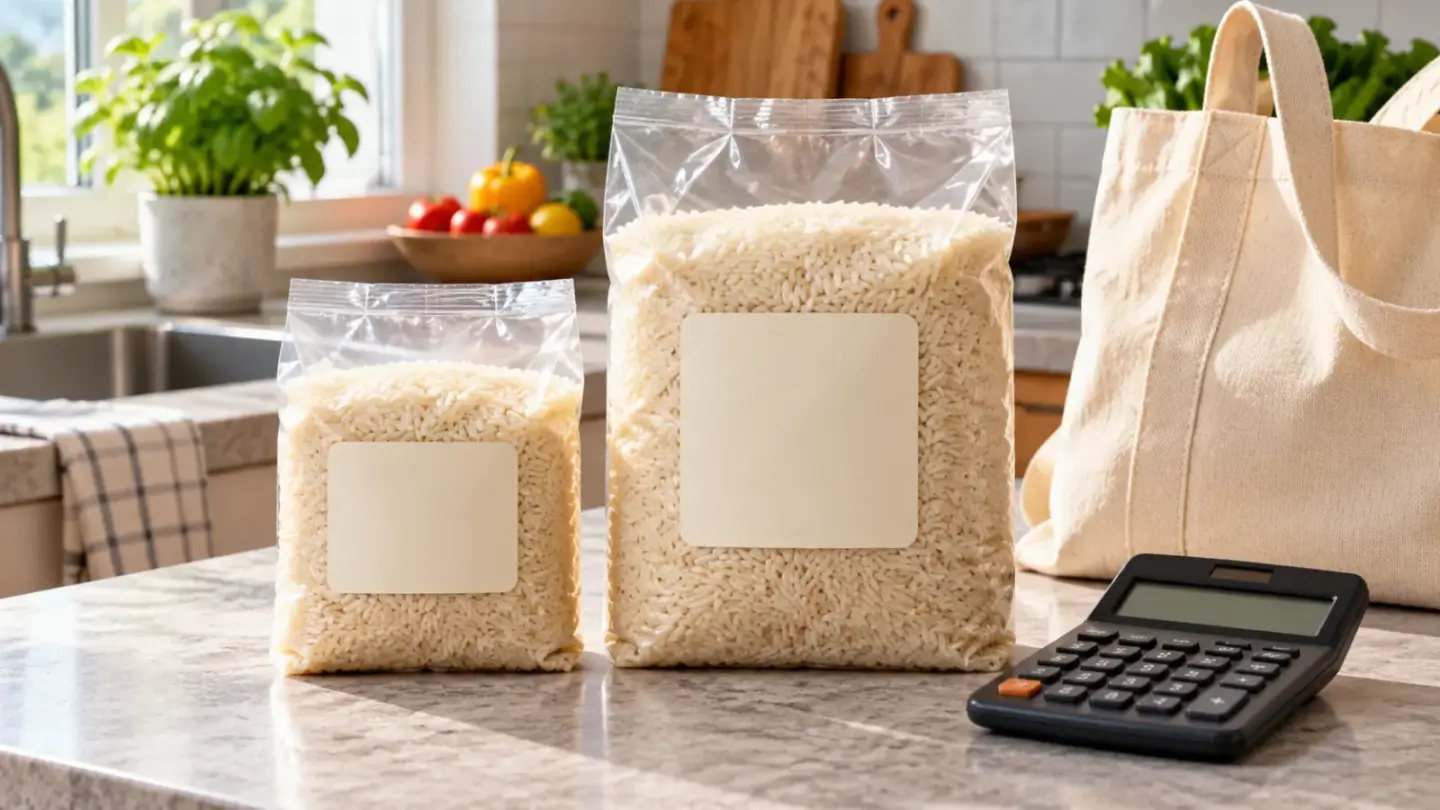
The basic calculation is selling price divided by quantity, using the same units for all alternatives. If a fictional 400-gram pack costs $2.40, its price is $2.40 ÷ 0.4 kilograms, or $6 per kilogram. A fictional one-kilogram pack at $5.50 costs $5.50 per kilogram. The larger pack has the lower unit price in this example, although its checkout price is higher.
You can also calculate both per 100 grams: the 400-gram pack is $0.60 per 100 grams, while the one-kilogram pack is $0.55 per 100 grams. These are the same comparison expressed differently. Do not compare $0.60 per 100 grams directly with $5.50 per kilogram as if the displayed numbers used the same denominator.
Normalize before comparing
- Identify the selling price and the quantity in each pack.
- Choose one common unit, such as kilogram or litre.
- Convert every quantity to that unit.
- Divide price by quantity and label the result.
Keep currency units consistent too: dollars and cents are not interchangeable numbers.
Use displayed unit prices, but check their basis
The Australian Competition and Consumer Commission explains grocery unit prices as a way to compare value across products and package sizes. Look for the unit printed beside the amount. Labels may use different quantity bases for different product types, so a quick visual comparison should start with the denominator, not just the largest digits.
If the unit price appears inconsistent with the package or promotion, ask the retailer to clarify it. You can make your own calculation using the current selling price and quantity, but do not assume the shelf price will be corrected at checkout in a particular way. Store processes and local consumer rules differ.
| Pack | Selling price | Total quantity | Price per kilogram |
|---|---|---|---|
| Small bag | $2.40 | 400 g = 0.4 kg | $6.00 |
| Larger bag | $5.50 | 1 kg | $5.50 |
| Six small portions | $4.50 | 6 × 125 g = 0.75 kg | $6.00 |
Do not assume a multipack or larger size wins
The UK Competition and Markets Authority’s consumer explanation shows why the biggest pack is not necessarily the best value. Calculate rather than infer a discount from a label such as family size, value pack or bulk. Packaging language is not a substitute for the price and quantity.
For the fictional multipack in the table, six portions of 125 grams contain 750 grams in total. At $4.50, the unit price is $6 per kilogram, the same as the small bag. The individual portions may offer convenience, but there is no lower price per kilogram in this comparison. Keep convenience as a separate preference instead of calling it a mathematical saving.
Match what the products actually provide
Price per kilogram is most informative when the foods are reasonably interchangeable for your intended use. A different recipe, concentration, preparation state or usable portion can change the practical comparison. Read the product description and ingredients rather than assuming that two similar-looking containers provide the same thing.
Do not convert mass to volume without an appropriate basis. A kilogram and a litre describe different quantities, so a price per kilogram cannot automatically be compared with a price per litre. For products used by measured dose, follow the manufacturer’s directions and compare the relevant stated use conditions; do not change a safe dose merely to improve a cost calculation.
Check promotions and eligibility separately
Record whether a displayed promotional price requires a minimum quantity, membership or another condition. A two-pack offer should be compared using the total amount you must buy and the total charge you actually qualify for. If a later rebate is involved, distinguish the payment at checkout from a conditional future benefit.
Suppose a fictional offer is two 400-gram bags for $4.40. The combined quantity is 0.8 kilograms, giving $5.50 per kilogram. That matches the one-kilogram bag in the earlier example, but the shopper spends $4.40 rather than $5.50 and receives less food. Equal unit price does not mean equal checkout cost or equal quantity.
Make the purchase decision in order
- Are the products suitable substitutes for the planned use?
- Which eligible price has the lower cost per common unit?
- How much food will the household realistically use?
- Does the total purchase fit the current budget and storage space?
The lowest unit price answers only one of these questions.
Account for food you may not use
EPA’s household food-waste guidance recommends planning purchases around what will be used and checking existing food first. Apply that practical constraint before buying more simply for a lower unit price. Appropriate storage and safe use matter; a bargain is not a reason to keep or eat questionable food.
As a hypothetical exercise, if a $5.50 one-kilogram bag yields only 600 grams that you actually use, the purchase cost allocated to the used amount is about $9.17 per kilogram. This is a planning illustration, not a new shelf unit price or a prediction of waste. It shows why a smaller suitable purchase can make sense even when its displayed price per kilogram is higher.
Keep checkout spending visible
If you need 800 grams for planned meals, two of the fictional $2.40 small bags cost $4.80. The one-kilogram bag costs $5.50, or $0.70 more at checkout while leaving 200 grams for later. Whether that extra food is useful depends on your plans. The calculation should not silently assume that all leftovers are wasted or that all will definitely be used.
Consider other groceries in the basket too. Spending more on one bulk item may reduce cash available for something needed this week. Unit pricing helps compare product quantities; it does not decide the household’s priorities. A short shopping list and a running total can keep both questions visible without turning the trip into a complicated accounting exercise.
Use a repeatable comparison habit
Choose a few frequently purchased products and practice checking their quantity, eligible selling price and unit price. Recheck when package sizes or offers change. If you keep notes, include the store, date and exact pack size so that a later comparison does not mistake a smaller package for an unchanged price.
The budget planner can organize actual grocery spending. Our methodology explains the use of fictional arithmetic, and the contact page accepts corrections. Report the result as a comparison under stated assumptions, not a guaranteed annual saving. The practical aim is to buy a suitable amount at a price you understand.
Related guides
Continue with Reducing Food Waste: A Household Checklist With Trackable Savings and Grocery Loyalty Offers: Comparing Real Savings and Privacy Trade-Offs. Each guide identifies its scope and any country-specific rules.
Common questions
What is the basic unit-price formula?
Divide the selling price by quantity after converting the options to the same unit. Keep the calculation’s basis visible, such as price per 100 grams. The result compares quantity costs; it does not by itself establish whether two products are equally suitable for your needs.
Is a larger package always cheaper per unit?
No. Calculate the exact offers or compare their displayed unit prices on the same basis. Promotions and package sizes can change the result. Even when the larger pack is cheaper per unit, consider whether you can afford, store and use the quantity you would buy.
Can I compare a price per kilogram with one per 100 grams?
Convert them first. One kilogram contains ten amounts of 100 grams, so a price per kilogram divided by ten gives the equivalent price per 100 grams. Comparing the printed numbers without adjusting the units can reverse which package appears less expensive.
Does a multipack automatically provide a discount?
No. Add the quantities inside the pack and divide its eligible selling price by that total. Check whether the individual containers match the size you assumed. A bundle label is not evidence of a discount until the unit price is compared with a relevant alternative.
Are kilograms and litres interchangeable?
No. Kilograms measure mass and litres measure volume. Use consistent units within the comparison rather than assuming the numbers can substitute for each other. If products are labelled on different bases, obtain an appropriate basis for comparison instead of making an unsupported conversion.
What if a promotion requires membership?
Use the price you actually qualify for and record conditions such as membership or minimum quantity. Include a relevant additional cost when it is part of obtaining the offer. A shelf promotion that you cannot use is not the effective price for your shopping decision.
Should I always choose the lowest unit price?
No. Also consider suitability, the amount needed, safe storage, likely use and checkout affordability. A lower unit price can require more cash and produce unused food. The calculation informs the choice; it does not require buying the largest quantity or a product you do not want.
Does unused food change the shelf unit price?
No. The shelf calculation remains price divided by purchased quantity. Unused food changes how much value your household gets from the purchase, which is a separate planning question. Track realistic use and follow safe-storage guidance rather than treating all purchased quantity as necessarily consumed.
Are the prices in the table real supermarket offers?
No. They are invented numbers designed to make the quantity conversions easy to check. They are not current offers or evidence about a named retailer. Apply the method to the actual package quantity, eligible price and conditions displayed during your own comparison.
Do unit-pricing laws work the same everywhere?
No. The NIST, Australian and UK resources operate in their respective contexts. The arithmetic is broadly useful, but legal display requirements should be checked locally. This guide does not determine that a particular label complies with every jurisdiction’s rules.
Sources and references
- NIST: Unit Pricing Guide, 2025 edition
- ACCC: Unit prices for groceries
- CMA: Unit pricing information for consumers
- EPA: Preventing Wasted Food at Home
Sources checked October 17, 2026. No real store-price survey or measured savings result is claimed.