Reducing Food Waste: A Household Checklist With Trackable Savings
Use a simple household log to measure discarded food, test practical changes and distinguish estimated food value from actual cash savings.
On this page
- Choose a simple baseline you can maintain
- Separate preventable purchases from unavoidable scraps
- Find the recurring cause before buying solutions
- Keep storage and safety decisions separate
- Estimate discarded purchase value carefully
- Check cash savings against receipts and inventory
- Make the routine easy for everyone
- Review one change and decide what comes next
- Related guides
- Common questions
- Sources and references
A useful food-waste project starts with observation, not a promise to save a fixed amount every month. Record what leaves your kitchen uneaten, why it happened and what it originally cost when that information is available. Then change one repeated problem and compare similar periods. This approach can reveal practical improvements without turning a guessed value of leftovers into an invented cash saving.
This is a general household workflow using explicitly identified US food-safety resources. Storage guidance and date-label rules vary by food and location. Food safety comes before a waste target: do not eat questionable food merely to improve a tracking result, and do not use smell or appearance as proof that food is safe.
Choose a simple baseline you can maintain
Start with a manageable observation period, such as one ordinary week, and write down any unusual circumstances. Guests, travel, illness or a large celebration can change the result. The point is to describe the week accurately, not to create a perfect-looking score. Keep the same measurement method when you repeat the exercise.
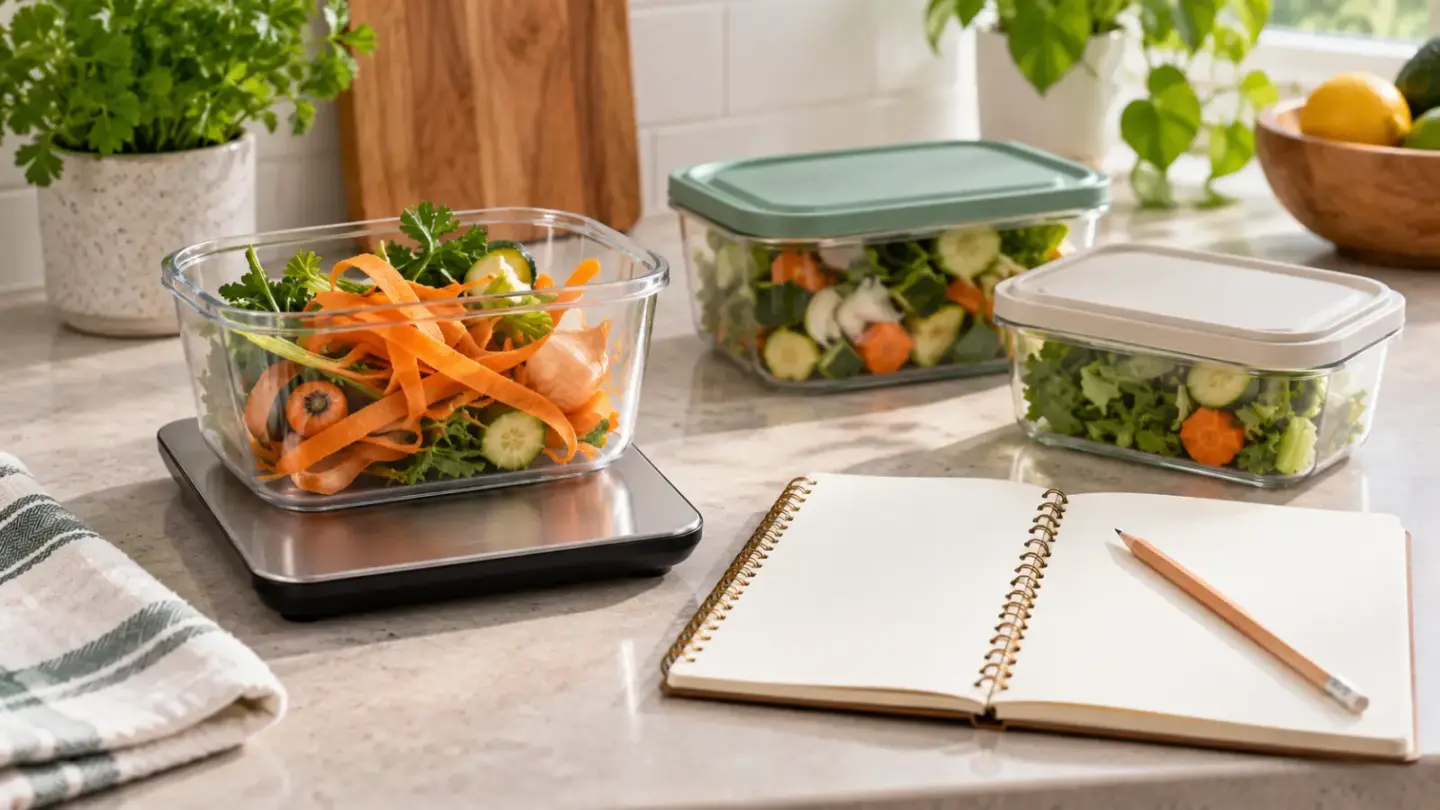
A notebook can have five columns: item, approximate amount, reason discarded, purchase information and possible next action. If you weigh food, note the container weight and keep packaging separate. If weighing is impractical, use consistent portions or item counts. Avoid mixing grams, handfuls and whole packages into one total that appears more precise than the underlying observations.
Record a useful observation
- What: identify the food and amount.
- Why: record the immediate reason it was discarded.
- Context: note schedule changes or missing storage information.
- Next action: choose one adjustment you can test.
A short factual record is more useful than a judgement about whether the household was “good” or “bad.”
Separate preventable purchases from unavoidable scraps
EPA’s assessment resources explain the value of tracking the amount, type and source of wasted food. Its tools include material designed for organizations; a household should adapt the principle to a small practical record rather than claim to have performed a formal commercial audit.
For your own worksheet, distinguish food bought to be eaten but discarded from preparation scraps that you did not plan to eat. Keep the categories consistent. Otherwise a week with more fresh produce could look worse merely because it produced more peelings. You can record both categories without pretending every scrap represents a purchase that could have been avoided.
Find the recurring cause before buying solutions
EPA’s household guidance recommends checking existing food, planning meals and buying quantities you expect to use. Apply that to the pattern in your notes. If bread is repeatedly discarded after buying a promotional extra loaf, the first experiment might be a smaller purchase rather than a new storage gadget.
Other patterns need different responses. An unopened ingredient may have been bought for a recipe that never fitted the week’s schedule. Leftovers may have been forgotten behind new groceries. A large cooked portion may not match the number of people eating at home. Write one specific cause and one corresponding experiment; “be less wasteful” is too vague to evaluate later.
| Observation | Possible experiment | What to record next time |
|---|---|---|
| Extra bread left uneaten | Buy a smaller amount or plan suitable storage | Quantity bought, used and discarded |
| Leftovers forgotten | Label and place safely in a visible designated area | Preparation date and whether the planned meal happened |
| Recipe ingredients unused | Choose meals that fit the actual schedule | Cancelled meals and ingredients carried forward |
| Large portions returned from plates | Serve a smaller initial portion with more available | Servings and uneaten portions, without pressuring anyone to eat |
Keep storage and safety decisions separate
The FoodKeeper resource provides food-specific storage information. Use an appropriate authoritative resource for the particular food instead of applying one shelf-life rule to everything in the refrigerator. Follow product instructions and local guidance, including any requirements relevant to a person’s health circumstances.
FDA explains that “Best if Used By” is a quality phrase in its US guidance. That explanation is not permission to ignore every date label, special product requirement or unsafe storage history. Record uncertainty as uncertainty. If you cannot establish that food has been handled safely, do not try to compensate for missing information by making the waste log look better.
Estimate discarded purchase value carefully
Suppose a fictional package costs $4 and contains eight equal portions. If two portions are discarded, a simple allocation of purchase cost is $1. This estimate assumes the portions are equal and excludes preparation costs. It describes the value assigned to discarded food; it does not prove that the household’s bank balance improved by $1 when the same food was used the following week.
For mixed leftovers, exact allocation may require more effort than it is worth. You can mark the cost as unknown while still recording the amount and reason. Avoid assigning an entire grocery receipt to a small discarded portion. A transparent rough estimate is preferable to an exact-looking number built from inconsistent assumptions.
Keep three results separate
- Food discarded: an amount measured consistently.
- Estimated purchase value: a labelled allocation based on known prices.
- Cash spending: actual purchases over comparable periods.
Less discarded food and lower spending are related possibilities, not automatically the same measured outcome.
Check cash savings against receipts and inventory
Imagine grocery spending falls from $70 one week to $60 the next. The $10 difference is real arithmetic, but its cause is not yet established. Perhaps you used pantry stock, ate away from home, hosted fewer people or postponed a bulk purchase. Note those changes before attributing the full difference to your waste-reduction experiment.
Compare similar periods and keep an opening and closing note about major pantry or freezer purchases. You do not need a business inventory system; a note that one week included a large rice purchase may be enough to prevent a misleading conclusion. If you report results to the household, state both the observation and the limitation: less bread was discarded, while total spending also changed for other reasons.
Make the routine easy for everyone
Choose a shared location for the log and a short review time. Describe discarded items without blaming the person who bought or served them. Ask which adjustment would be easiest to maintain. A system that requires every meal to be weighed may fail in a busy household, while a quick note about recurring purchases may be sustainable.
Keep food handling hygienic while recording. Do not leave perishable items out for a photograph or repeatedly handle discarded food to improve measurement. A rough note made during normal cleanup is acceptable. The tracking method should fit a safe kitchen routine, rather than turning waste into something that has to be stored or examined unnecessarily.
Review one change and decide what comes next
At the end of the next comparable period, check whether the selected problem occurred less often and whether the change created inconvenience or extra cost. Keep a successful adjustment, revise an impractical one and record what remains unknown. Progress can mean understanding a recurring cause even when the first experiment does not reduce spending.
The monthly budget planner can organize actual grocery expenditure; it does not measure food waste. Our research methodology explains how illustrative calculations are labelled, and the contact page accepts corrections to this guide. Use your own consistent observations for household decisions, and keep broad national waste statistics separate from claims about your personal savings.
Related guides
Continue with Building a Weekly Meal Budget Around the Food You Already Have and Reusable vs Disposable Products: Calculating Costs Without Greenwashing. Each guide identifies its scope and any country-specific rules.
Common questions
Do I need a kitchen scale?
No. Consistent portions or item counts can reveal useful patterns without buying equipment. Choose a measurement approach you can repeat and record unlike items separately. Combining a count of containers with a weight of food into one total would create a misleading comparison.
Should vegetable peelings count as wasted purchases?
Record preparation scraps separately from food purchased to be eaten but later discarded. The distinction helps identify what a shopping or storage change could realistically affect. Use the same categories across tracking periods so an apparent improvement is not merely a change in classification.
Does using leftovers prove I saved money?
Not by itself. Using food may reduce waste, while actual spending also depends on purchases and inventory changes. Record those separately from an estimated value of discarded or used food. Otherwise, a calculation can claim cash savings that have not actually appeared in the household budget.
Can I rely on smell to decide food is safe?
No. Smell and appearance are not guarantees that food is safe. Use food-specific storage and handling guidance, including the circumstances of the item. A waste-reduction goal should never turn an uncertain safety decision into an instruction to eat or retain questionable food.
Does “Best if Used By” mean every date can be ignored?
No. The FDA explanation cited here concerns a particular US quality phrase. Other labels, foods, storage histories and jurisdictions need their own interpretation. Do not convert that limited explanation into a rule that every printed date or food-safety concern can be disregarded.
What if I do not know what a leftover portion cost?
Mark the price unknown rather than inventing a precise amount. You can still record the portion and the reason it was discarded, then use that pattern to adjust planning. If estimating later, label the basis and keep estimated value separate from verified cash spending.
Should I buy storage equipment immediately?
First identify the recurring problem in your records. The cause may be purchase quantity or timing rather than a lack of containers or appliances. Test a practical change that addresses the observed issue, and evaluate any new purchase on its own cost and usefulness.
How long should I track?
Choose a manageable period and repeat the same method so comparisons are meaningful. Note unusual circumstances such as travel or guests. A single atypical week can reveal a problem, but it should not automatically be presented as the household’s normal annual pattern.
Are the dollar examples actual savings results?
No. They illustrate allocation and comparison using hypothetical figures. They are not measured results or a promised reduction in grocery bills. Track your actual purchases, quantities and inventory changes before claiming that a change has produced a particular amount of cash savings.
What if reducing waste conflicts with safety?
Safety takes priority. Do not consume or retain questionable food to improve a tracking total. Use appropriate storage and handling guidance, and record the discard honestly. The record can help prevent a similar purchasing or storage problem later without making the current item safe to use.
Sources and references
- EPA: Resources for Assessing Wasted Food
- EPA: Preventing Wasted Food at Home
- FoodSafety.gov: FoodKeeper
- FDA: How to Cut Food Waste and Maintain Food Safety
Sources checked October 17, 2026. No individualized dietary or food-safety assessment is claimed.