Bedding Labels and Ownership Costs: Materials, Care and Replacement
Read bedding composition, dimensions and care information separately from marketing claims, then compare the cost of useful pieces and a practical care routine.
On this page
- Start with the product and the pieces
- Read fiber content separately from marketing
- Look carefully at bamboo descriptions
- Use care instructions as practical information
- Check whether the care routine fits your home
- Compare ownership costs using explicit assumptions
- Plan replacement around condition and actual need
- Related guides
- Common questions
- Sources and references
A bedding label can help you understand what a product contains, how it should be cared for and whether it fits your bed. It cannot by itself promise a particular lifespan or prove every comfort claim on the packaging. Compare the full specification, the care routine and the cost of the pieces you will actually use. This guide explains a practical shopping method, with US labeling examples and international care-symbol guidance clearly distinguished.
Start with the product and the pieces
Write down what you need before comparing sets. A fitted sheet, flat sheet, duvet cover, pillowcase and filled bedding item serve different purposes. Count the included pieces and check whether a photograph shows accessories that are not part of the purchase.
Measure the mattress and any topper, including the depth relevant to a fitted sheet. Check the product’s actual dimensions instead of relying only on a size name. Also compare pillowcase and duvet-cover dimensions with the items you already own.
A larger set is not automatically better value if some pieces will remain unused. Make a short list of required pieces, optional extras and existing items you can keep. This turns the comparison into a household purchase decision rather than a competition over the number printed on the package.
Read fiber content separately from marketing
The US Federal Trade Commission explains that most covered textile products require information about fiber content, country of origin and the responsible business. Its guidance includes many bedding products, such as sheets, covers and pillowcases, while identifying exceptions. These are US labeling requirements, not a statement of every country’s rules.
Read the full composition rather than only a prominent material name. Where a product has different components, check which description applies to each part. A statement about the cover should not silently become an assumption about the filling or every piece in a set.
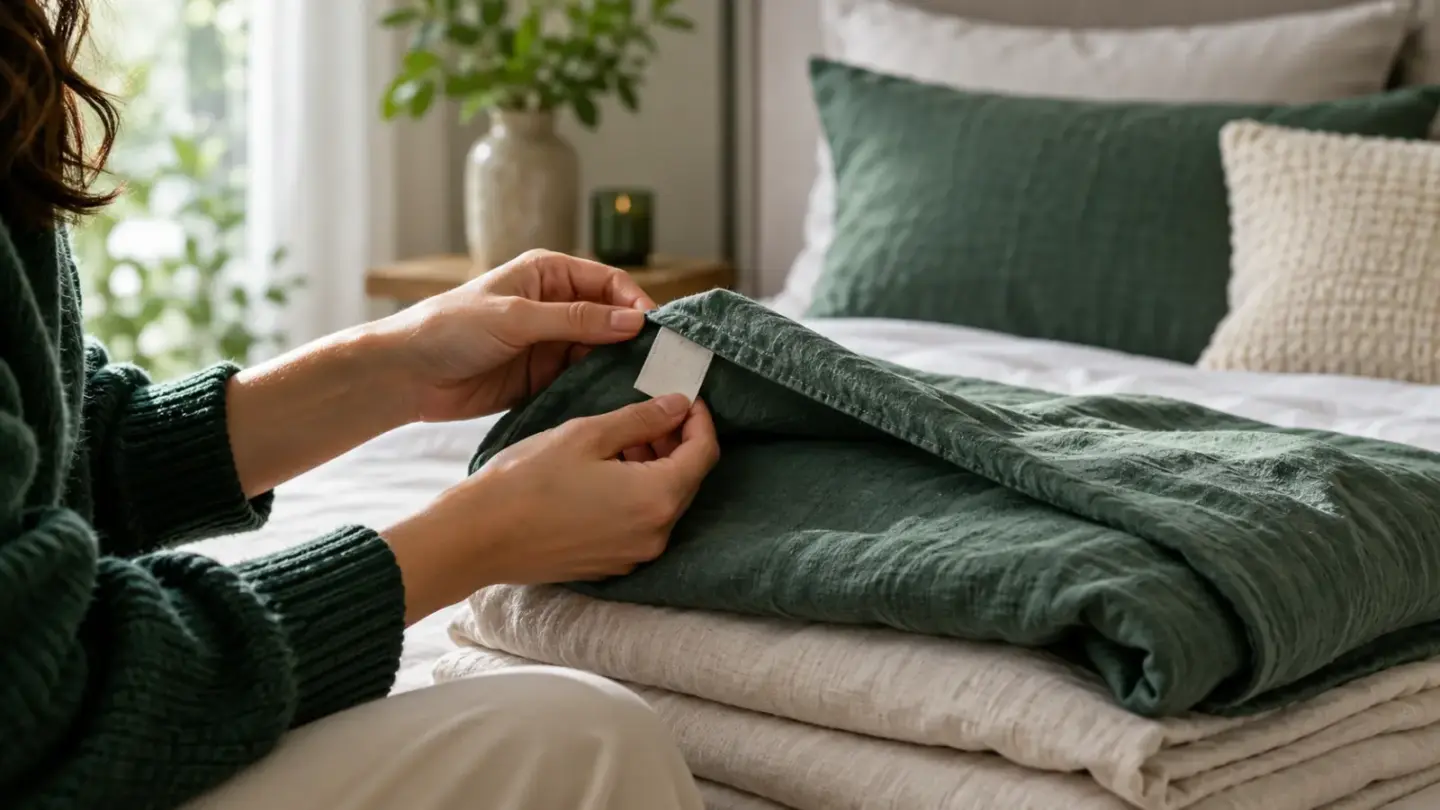
Keep a screenshot or photograph of the specification offered at purchase. If the delivered item’s label differs from the listing, ask the seller to explain before deciding what to do. A clear record is more useful than trying to reconstruct the advertisement after it changes.
| Information | What to check | Decision it supports |
|---|---|---|
| Composition | Actual fiber names and relevant components | Whether the product matches the advertised material |
| Dimensions | Measurements, depth and included pieces | Whether it fits existing bedding and the mattress |
| Care | Washing, drying and other restrictions | Whether the household can follow the routine |
| Claims | Evidence behind specific performance statements | Whether a claim is supported rather than assumed |
| Ownership cost | Purchase and relevant care expenses | Whether the complete commitment fits the budget |
Look carefully at bamboo descriptions
The FTC warns that soft textiles advertised as bamboo are often rayon or viscose made from processed bamboo. The resulting textile should not be assumed to retain the original plant’s properties. In particular, the agency says there is no evidence that rayon made from processed bamboo is naturally antibacterial.
Ask for the actual fiber description and support for any specific environmental or performance claim. A plant illustration, reassuring colour scheme or broad word such as “natural” does not answer those questions. Evaluate the claim that is actually made about the finished product.
This does not require treating every unfamiliar material as unsuitable. It means distinguishing composition from claims about what the product will do. If a claim matters to your purchase and the seller cannot explain it, keep that uncertainty visible in the comparison.
Use care instructions as practical information
GINETEX explains that its care-symbol system covers washing, bleaching, drying, ironing and professional care. A number in a washing tub identifies a maximum washing temperature, while bars indicate milder treatment. A maximum is not an instruction to choose the hottest permitted setting every time.
Read the whole care instruction together. A washing symbol alone does not tell you how the item should be dried, and permission for one treatment does not imply permission for all others. If the symbols or wording are unclear, use the manufacturer’s explanation for the exact product.
Keep legal scope separate from practical usefulness. The FTC’s Care Labeling Rule guidance concerns clothing and certain piece goods for making apparel. It should not be cited as proof that every bedding product has the same mandatory care-label requirements. You can still ask a bedding seller for reliable care information before buying.
- Identify the item, composition and included components.
- Check dimensions against the bed and existing bedding.
- Read washing and drying instructions together.
- Ask for clarification before relying on an unfamiliar claim or symbol.
Check whether the care routine fits your home
Consider the equipment and space available. Can the item be cleaned using the permitted method with your appliance’s documented capacity? Is the allowed drying method practical where you live? Large items may need a different arrangement from ordinary sheets, so check rather than assuming they belong in the same load.
Ask about any professional cleaning requirement and obtain a relevant local quote if that cost matters. If you intend to use shared laundry facilities, check their available settings and restrictions. A low purchase price is less helpful if the required care arrangement is unavailable or inconvenient.
Do not improvise stronger chemicals, higher temperatures or a different drying method to solve a care difficulty. Product instructions and appropriate professional advice should guide treatment. This article does not prescribe infection-control washing, allergy treatment or a medical bedding routine.
Compare ownership costs using explicit assumptions
For an original fictional comparison, bedding A costs 60 currency units and has an assumed allocated care cost of 1.20 for each of twenty cleaning cycles. The modeled total is 84. Bedding B costs 80 and has an assumed allocated care cost of 0.80 per cycle, giving a total of 96 over the same twenty cycles.
In this example, A remains 12 less expensive over the chosen period, despite having the higher assumed care cost per cycle. The figures are invented. They are not measured energy use, local laundry prices, recommended cleaning frequency or a prediction that either product will survive a particular number of washes.
Allocation matters when several items share a load. Do not charge the full cost of the same wash to every individual item and then add those costs together. Use a consistent, clearly stated method for both products, or keep shared laundry costs outside the comparison if you cannot estimate them meaningfully.
- A: purchase 60 + (20 × 1.20) = 84.
- B: purchase 80 + (20 × 0.80) = 96.
- Difference over the modeled period: 12.
- Assumed costs and cycle count are illustrative, not tested performance.
Plan replacement around condition and actual need
A material name or warranty length does not give this guide enough evidence to predict a replacement date. Inspect what you own and identify the practical problem: a poor fit, damage, missing pieces or a care routine that no longer works. Replace the relevant item rather than assuming an entire matching set must always be discarded.
Before purchasing, check the seller’s return conditions, especially for opened or used bedding. Record any trial separately from a warranty and from applicable consumer rights. Do not assume a return is available simply because the product feels different from the advertisement.
Use the monthly budget tool for a fictional purchase allowance and our editorial policy to understand the limits of untested examples. Report an unclear source claim through the contact page. This guide does not rank brands, certify materials or claim that a bedding product will improve a medical condition.
Related guides
Continue with Buying a Mattress: Trial Terms, Durability and Warranty Questions and Cost per Wear: A Practical Way to Compare Clothing Purchases. Each guide identifies its scope and any country-specific rules.
Common questions
Does a material name tell me everything about a bedding set?
No. Check the full composition, relevant components, included pieces, dimensions and care instructions. A prominent name may describe only part of the information needed for a purchase.
Are bedding size names enough to confirm fit?
Use actual measurements as well as the name. Compare mattress depth, toppers, pillowcases and duvet dimensions with the stated product measurements before ordering.
Is rayon made from bamboo naturally antibacterial?
The FTC says there is no evidence that processed bamboo rayon retains that natural antibacterial property. Ask for reliable support for claims about the finished textile.
Does a washing temperature symbol require the hottest setting?
GINETEX describes the number as a maximum temperature. Read the complete care instruction, including treatment severity and drying information, rather than treating the maximum as a universal target.
Does the US clothing care rule automatically cover all bedding?
No. The FTC guidance concerns clothing and certain apparel piece goods. Do not confuse that scope with separate textile labeling requirements or the usefulness of bedding care information.
Should I compare only the price per piece?
No. Check which pieces you actually need and whether their dimensions and functions match. Unused extras do not necessarily make a larger set better value.
Are the twenty cleaning cycles a recommended washing schedule?
No. They are an invented count for the cost calculation. Follow appropriate product care guidance and your circumstances rather than treating the example as hygiene advice.
Can the article predict how long sheets will last?
No. It provides no durability testing or product-specific lifespan evidence. A material description, purchase price or warranty length alone does not establish a replacement date.
How should shared laundry costs be allocated?
Use a consistent stated method if you estimate them. Avoid assigning the entire cost of one shared load to every item and then adding those amounts together.
Can I return bedding after opening it?
That depends on the seller’s conditions and applicable rights. Check the actual policy before purchase, including restrictions for opened or used items and any separate trial arrangement.